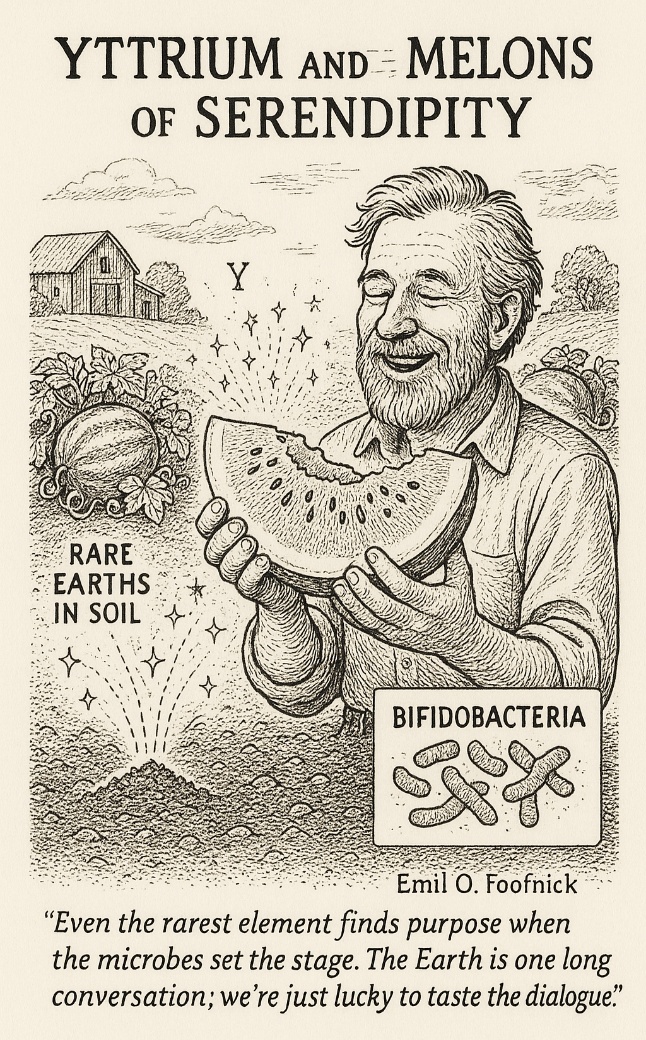
🍉 II. “Yttrium and the Melons of Serendipity”
There’s a patch of soil behind Emil’s barn where the melons grow like gossip—round, fat, impossible to keep secret. Folks said he sang to them. Emil claimed it was the yttrium.
🧭 The Discovery
It started when a visiting geochemist—clipboard, boots too clean—tested the soil and frowned.
“Professor Foofnick,” he said, “your patch is laced with rare-earth elements. Yttrium, lanthanum, cerium… this is electronics-grade dirt.”
Emil only chuckled. “Maybe that’s why my melons have such good reception.”
🌾 The Strange Benefactor
Turns out, yttrium masquerades as calcium in the soil—slips quietly into the plant’s plumbing.
At homeopathic doses, it tickles the plant’s enzymes, wakes up antioxidant defenses, and nudges sugar synthesis.
The vines grow lustier, the fruits denser, the sweetness sharper.
Emil wrote in the margin:
“The melon that ate a star and learned to shine from within.”
Scientists later confirmed the hunch: rare-earth traces can enhance chlorophyll, root vigor, even drought resilience.
Not essential, but encouraging, like a good friend who shows up just when you’re flagging.
🦠 The Invisible Bridge
When those melons reach your table, you take in more than fructose and water.
Inside each bite lie subtle molecules—polyphenols tuned by that mineral whisper.
And when those reach your colon, the Bifidobacteria throw a party.
They ferment the fruit’s fibers into short-chain fatty acids, polish the antioxidants, and pass the favor on to your cells.
“From rock to rind to microbe to mind,” Emil wrote, “yttrium completes the circle.”
🍃 The Moral
No one calls yttrium essential, and yet without its quiet cameo, Emil’s melons lost a bit of their music.
He looked at a slice glowing pink in the sun and murmured,
“Even the rarest element finds purpose when the microbes set the stage.
The Earth is one long conversation; we’re just lucky to taste the dialogue.”
He took a bite, wiped his chin, and grinned.
“That’s all I have to say,” he said. “I will say no more.”
Leave a Reply