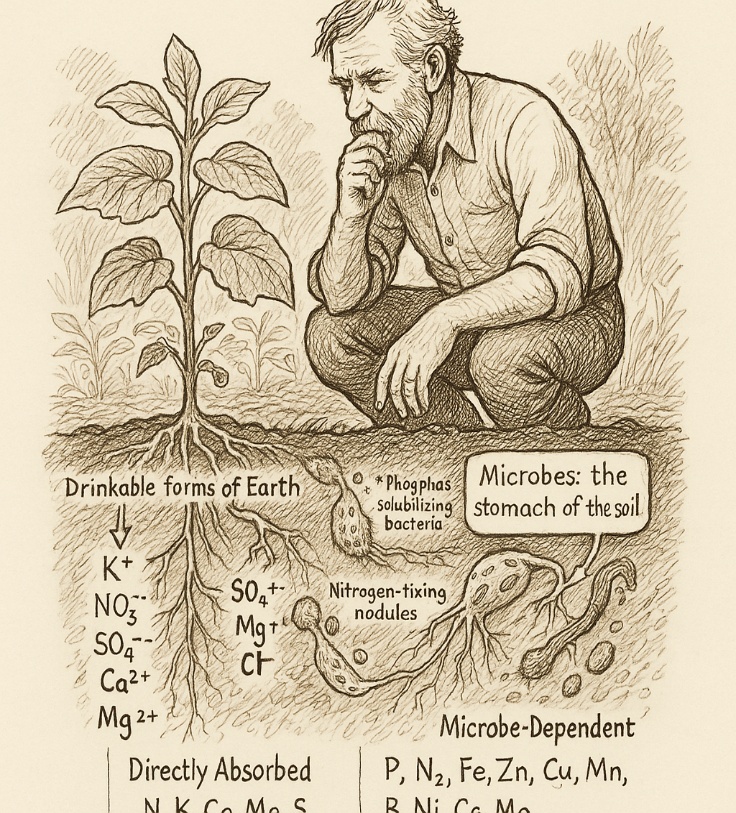
🌱 I. “The Feast Beneath Our Feet”
Emil O. Foofnick stood at the edge of his garden, gray hair glinting in the morning light, one hand on a hoe, the other on his chin.
“Funny thing,” he said to nobody in particular, “how a tomato never thanks the rock it came from.”
He scooped a handful of soil—crumbly, fragrant, alive. To most folks, it looked like dirt. To Emil, it was a banquet table set for billions.
🌿 The Direct Diners
Down among the roots, some elements arrive at the table already dressed for dinner. They’re the polite guests—soluble, charged, ready to mingle.
Potassium (K⁺) slips in like a quick wit, balancing charge wherever conversation gets heated.
Calcium (Ca²⁺) stiffens cell walls—“the spine in a celery stick,” Emil would say.
Magnesium (Mg²⁺) takes the green seat at the head of chlorophyll’s table.
Sulfur and chlorine join quietly, seasoning proteins and regulating the watery talk between cells.
“These,” Emil wrote in his notebook, “are the self-starters—the elements that go straight from soil solution to supper.”
🧫 The Microbial Chefs
But half the feast stays locked in the kitchen. Phosphorus trapped in rock, iron rusted tight, zinc and copper bound up like stubborn secrets. That’s when the microbial chefs go to work.
Bacteria, with names longer than your garden hose—Bacillus, Pseudomonas, Azospirillum—brew acids and siderophores that pry open minerals.
Fungi, those thread-thin scavengers, reach miles in miniature to fetch nutrients the roots can’t touch.
Mycorrhizae trade sugars for phosphates, Rhizobium swaps nitrogen from thin air for a cozy nodule on a legume root.
“They digest the mountain,” Emil mused. “Without them, the plant would starve surrounded by plenty.”
🧩 The Marriage of Matter and Life
He sketched it in his field book:
Rock → Microbe → Root → Leaf → Fruit → You.
Each arrow a handshake, each handshake a promise.
That’s how iron gets from basalt to beet greens, how molybdenum sneaks into peas, how selenium rides through garlic into your own antioxidant defenses.
It’s the grand relay of chemistry turned cuisine.
And when someone asked Emil if plants really “need” microbes, he smiled.
“Friend, the plant is just the mouth,” he said. “The soil microbiome is the stomach. One chews, the other swallows.”
He brushed the dirt from his hands, looked at his lunch—carrots, beans, a thick tomato slice—and said,
“We are, all of us, compost in waiting and chemistry becoming. Eat with gratitude.”
That’s all he had to say. He said no more.
Leave a Reply