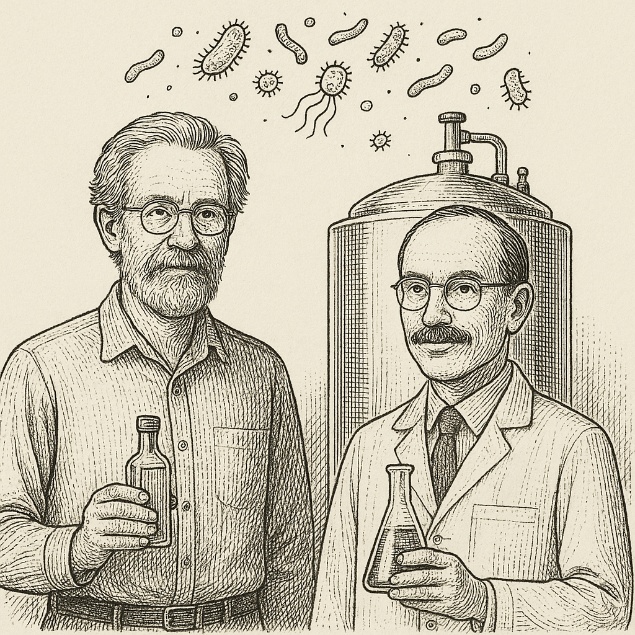
If you ever meet a man who can coax life out of powder and turn a vat of sugar broth into a civilization, tip your hat. Randolph Porubcan was one of those men. He didn’t just grow probiotics—he raised them like a shepherd raises lambs, with patience, precision, and a touch of divine mischief.
Randolph built fermenters not as machines, but as living ecosystems—gleaming stainless-steel wombs where bacteria learned discipline. He filed patents the way a poet writes sonnets: carefully, with structure, and with a twinkle that said, “This might just work.”
His inventions taught probiotics how to survive the modern world. Patent after patent—from culture stabilization to controlled fermentation and freeze-drying—read like a symphony of survival. He found ways to feed bacteria just enough to grow strong, but not so much that they lost their grit. His fermenters managed oxygen tension, pH, redox potential, and nutrient flow like an orchestra conductor balancing brass and strings.
It’s no small thing to teach microbes manners. And Randolph did it all before “probiotic” became a grocery-store buzzword.
Culture, Not Just a Culture
You start with a seed culture—meticulous, temperamental, freeze-dried, and alive.
Randolph started there too. He believed microbes were like musicians—each strain had its own temperament. Lactobacillus liked it warm and gentle, Bifidobacterium wanted it tight and low-oxygen. So he built systems to give each one its perfect microclimate.
His patents described fermenters under strictly anaerobic control, sparing no detail. He used nitrogen blankets, redox electrodes, custom impellers that stirred without shearing, and pH controls that could measure the difference between contentment and chaos.
What he understood—and what we still follow—is that how a microbe is raised determines how it performs later. Randolph’s fermenters didn’t just produce biomass—they produced endurance, resilience, and readiness for the long trip through glass, stomach, and time.
Layered Protections, Purpose-Built into each Bottle
It starts in a vault of glass. Randolph preferred glass—he used to say, “Plastic breathes like gossip, but glass keeps secrets.” Oxygen and moisture were his sworn enemies, so he used inert, non-porous glass to stand guard. Inside, tiny desiccants and oxygen scavengers worked like midnight janitors, sweeping away what could rust a living cell’s armor.
Vitamin C patrolled inside as the loyal sentinel against oxidation. “A sacrificial hero,” Randolph called it. “Dies so the others may live.”
And then came his crown jewel: the gastric armor. Randolph’s sodium-alginate encapsulation system—later refined and patented—was no small trick. He knew the stomach’s acid was nature’s executioner, so he taught alginate to be a shield. When the alginate met acid, it cross-linked into a tighter gel, forming a micro-fortress that kept the probiotics quiescent yet unbroken.
Inside that shell, he placed a buffer—trisodium phosphate (TSP)—his “little peacekeeper.” While the outer storm raged at pH 1.5, TSP kept the inner world above 4.0, just enough for the cells to wait it out. He liked to say, “You can’t fight acid—you can only buy time.”
The Passage and the Reawakening
When those capsules passed beyond the pylorus into calmer, more alkaline waters, bicarbonate softened the alginate, turning that once-rigid barrier into a soft, prebiotic gel. Randolph called it “the gentle landing.” The gel not only cushioned the cells but fed them—alginate itself a fermentable feast for the first arrivals in the colon.
And there, his other creation waited: LactoStim®, a patented blend of oleic acid and sunflower lecithin. This was Randolph’s poetic flourish—the moment of resurrection. Those lipids slipped into the bacterial membranes, patching, priming, and reminding the cells who they once were before the freeze-dryer took their breath. Within minutes of hydration, the microbes began to respire, metabolize, and multiply.
He had found a way to teach bacteria to “wake up fast, feed well, and get to work.”
Legacy in Motion
Every bottle of Theralac® or TruBifido® carries that lineage—Randolph’s fermenters, his patents, his refusal to let microbes die needlessly in the name of convenience. The man taught us that small life deserves big respect, and that precision in fermentation is an act of kindness.
His designs became the bones of an entire generation of probiotic technology—what we now call from the fermenter to your fermenter.
It’s a journey across glass, acid, bile, and time itself—each layer of protection a hymn to Randolph’s restless curiosity.
In Closing
So the next time you open a bottle and hear that faint hiss—the sigh of air leaving and life awakening—tip your hat to the man who taught microbes how to travel.
From the fermenter to your fermenter, every step bears his fingerprint. And that, dear reader, is the Foofnickian truth: great science isn’t just invention—it’s stewardship of the invisible.
That’s all I have to say; I will say no more.
Leave a Reply